The difference between voluntary and compulsory excess is who decides the figure: insurers set the compulsory excess, while you choose the voluntary excess, and only the latter can lower premiums.
When a claim happens, you have to pay the sum of both before insurance pays anything. This means the higher you set your voluntary excess to save on your premium, the more you’ll be paying out of pocket on your first big (or multiple small) claims. An attempt to save may end up costing you more.
This guide explains how each excess is applied in a real claim, how your compulsory amount is calculated, and a quick break-even calculation to help you choose a voluntary amount that saves you money.
Key Takeaways
- Your insurer sets the compulsory excess based on your age, driving experience, vehicle and claims history, and you can’t remove it from your policy.
- The voluntary excess is optional and can be set at £0, but if you choose a higher excess, your premium will be reduced.
- If you claim, you pay both excesses, and your insurance company will pay the remaining repair costs.
- It only makes sense to choose a high voluntary excess if the premium saving outweighs the added risk.
What Is Compulsory Excess vs Voluntary Excess?
Car insurance excess is a fixed amount that a policyholder must pay before the insurance covers the rest of the claim. The total is made up of two components:
- Compulsory excess: a minimum contribution from the insurer that is paid on all own-vehicle claims.
- Voluntary excess: the amount the driver can pay (usually in return for a lower premium).
- Total excess: compulsory + voluntary, as indicated in the policy documents.
The government-backed Money and Pensions Service guides that paying voluntary excess reduces the premium. But it also reduces the payout of any claim you make thereafter, as both amounts are deducted.
Choosing a higher excess means you can’t rely on insurance alone. If an accident happens, you pay the excess first, even if you chose a higher amount, before the insurance activates.
How Excess Affects the Premium and Payout?
Let’s look at the numbers to understand how premium and payouts are affected by a voluntary contribution:
In the first quarter of 2026, the average cost of accidental damage claims was 8% higher than the previous quarter, reaching £3,699.
Source: Association of British Insurers (ABI)
This means that a total excess of £400 on a £3,500 claim would cover about 10% of the total bill. The same excess absorbs the entire cost of a scrape that costs around £300.
It also explains that the amount you contribute to a damage will not be reimbursed or compensated by your insurer. This is where consciously choosing a voluntary excess that one can pay right on the spot is important.
How Do Different Types of Excess Work in a Real Claim?
The insurer pays the amount of repair cost minus the total excess. Choose a policy with a compulsory excess of £250 and a voluntary excess of £150, for a total of £400:
| Repair bill | Total excess | Insurer pays | Driver pays |
|---|---|---|---|
| £300 | £400 | £0 | £300 |
| £900 | £400 | £500 | £400 |
| £3,699 | £400 | £3,299 | £400 |
There are two points of interest.
First, the repair bill is calculated and compared with the total excess. If the damage exceeds the total excess, the driver's costs are capped at the excess amount.
Second, if the bill is less than the excess, it's 100% the driver's responsibility, and a claim is just a formality for record-keeping.
Some insurance companies take the excess from the driver up front, while others take it from the final settlement. The policy booklet indicates the method used.
Why Do Insurers Require Excess at All?
There are two reasons for excess. First, the payment deters small, unnecessary claims, which helps reduce administration costs and premiums for all drivers in the pool. Second, it motivates policyholders to drive carefully and park sensibly.
This makes the stake even more relevant today because of repair costs. The same ABI release reveals that £1.9bn of the £2.9bn of motor claims made in Q1 2026 was spent on vehicle repairs, driven by higher part prices and more advanced vehicles with sensors and cameras.
The fewer claims are submitted because of a higher excess, the less pressure insurers feel, and the more they can offer lower premiums.
What Decides Your Compulsory Excess?
Compulsory excess is a figure insurers calculate, and it varies by driver and provider. Common drivers include:
- Age and experience: young and newly qualified drivers typically have higher numbers.
- Vehicle profile: performance and luxury cars have higher excesses.
- Claims record: previous at-fault claims can increase the amount on a claims record.
- Insurer pricing model: two insurers can charge different rates for the same coverage.
- Excesses: sometimes there is an excess amount for event-specific claims such as windscreen, theft or fire.
Drivers can't avoid the compulsory element, but that doesn't mean they can't compare quotes. When comparing two policies with the same cover, it's practical to look at the excess alongside the premium before buying, as the fixed amount can vary significantly.
Does a Higher Voluntary Excess Always Lower the Premium?
Not always. Your insurance company calculates your premium primarily based on your risk of making a claim and the estimated cost of the claim. Increasing your voluntary excess, one of many factors influencing the insurance cost, doesn't guarantee a significant price reduction.
Each increase also saves you less than the last. For example, as a first-timer, raising your excess from £0 to £100 might cut £30 off your premium. But going from £400 to £500 might save just £5. With some insurers, the price barely changes.
How to tell if a higher excess is worth it
You need to know two things: how much extra you’d pay if you claimed, and how much you’d save each year. Then divide one by the other:
The break-even testing formula takes the guesswork out of it:
Extra voluntary excess ÷ annual premium saving = Claim-free years to break even before first claim.
Say you raise your voluntary excess from £100 to £400. You now pay £300 more if you claim. That reduces your premium by £40 per year, and it will take you 7.5 years, with no claims, to make up that £300.
Figure: This AI-generated chart of a worked example shows how a £40 yearly premium saving takes 7.5 claim-free years to cover a £300 rise in voluntary excess, from £100 to £400.
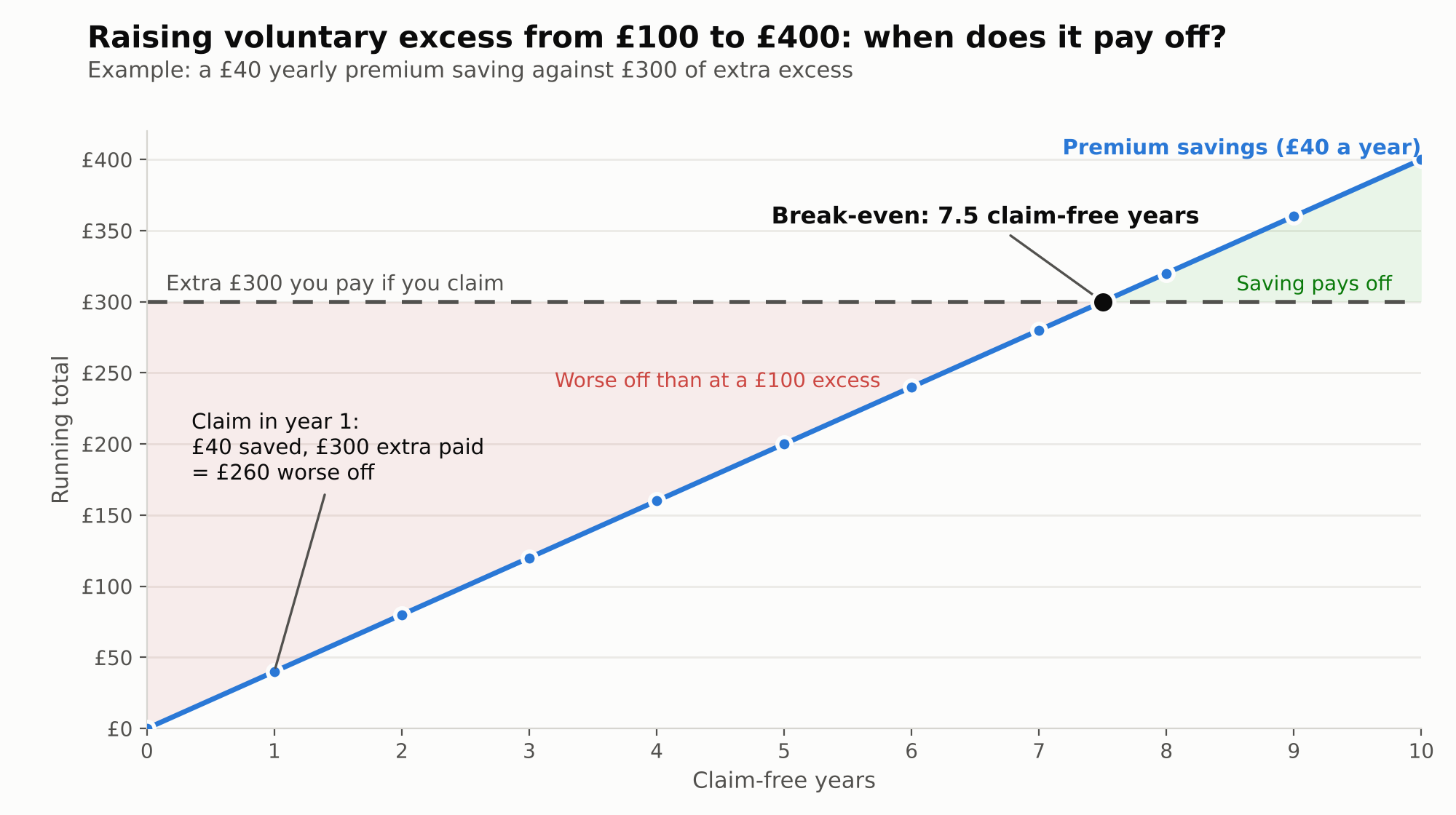
If you make a claim in the first year, you miss out. You save £40, but pay £300 more towards repairs, meaning you are £260 down.
When a higher excess is risky
If you park on the street, drive through busy town centres or drive in heavy traffic, you are more likely to have a small claim. In those situations, you could claim earlier than you break even so that a lower excess might be the better option.
Compulsory Excess vs Voluntary Excess: How Do They Compare Side by Side?
| Feature | Compulsory excess | Voluntary excess |
|---|---|---|
| Who sets it | Insurer | Driver |
| Can the driver change it | No | Yes, within options offered |
| Effect on premium | Built into the base price | A higher amount usually lowers the price |
| When it is paid | On every own-vehicle claim | Alongside compulsory excess |
| Optional | No | Yes, can be £0 |
Does the Excess Choice Change Which Quotes Appear?
Yes. Choosing a voluntary excess will alter the price you see and can make one policy appear cheaper than another, even if it isn't.
Each insurance company has its own variety of voluntary excess choices. Some offer just a handful of options, and some charge more for very low or very high amounts. So it can differ from one insurer to another when it comes to excess choices.
Companies set a subtle trap that you can easily fall for. On paper, a £350 quote with a £500 excess looks cheaper than a £370 quote with a £250 excess. Because you are saving £20 on the quote, but when a claim happens, and you’ve the cheaper policy of the two, you’ll be paying £250 more in excess.
How to compare fairly
- Make sure to use the same voluntary excess when comparing quotes.
- Check the total excess (compulsory plus voluntary), because the compulsory part varies between insurers.
- Then compare, putting like with like.
How Much Voluntary Excess Should You Choose?
Your choice of voluntary excess depends on how much you can pay in total excess within 48 hours out of pocket. Consider the two excess amounts as a whole and find a balance between them.
Take this stress test to be sure: if a claim happens next week, will the suggested voluntary excess, on top of the fixed excess, be hard to pay?
Practical guidance by situation:
- Low savings buffer: reduce voluntary excess to a minimum, as a lower premium will be of little value if the repair is delayed.
- Good maths: a higher number can be justified if the break-even maths checks out.
- High compulsory excess (typical for new drivers): a lower voluntary add-on makes it more affordable.
- Rarely driven vehicle: higher excess, lower odds of a claim.
Online policy comparison tools make it easy for policy buyers to test which voluntary excess is workable for them. By adjusting the voluntary excess in £50 or £100 increments, they can see where the savings level off and where to stop.
How Should Young and New Drivers Approach Excess?
Young and newly qualified drivers are at the front of the line. The compulsory excess for this group is normally higher, and premiums are already high. This increases their temptation to push the voluntary excess up and get some sort of relief in the cost of car insurance.
The risk is compounded here: a compulsory excess of £500 and a voluntary excess of £500 means a new driver will have a bill of £1,000 before they receive a single penny from their insurer.
A balanced approach is better than spiking voluntary excess. Keep the voluntary contribution moderate and then look for savings through telematics, a smaller engine, or a lower insurance group.
This helps balance voluntary versus compulsory excess and prevents a situation where a claim is valid but not financially viable to pursue.
Is It Always Worth Making a Claim?
Not always. If the excess is almost equal to the repair cost, paying the excess privately avoids a claim on the record. Nevertheless, the consumer association “Which?” points out that drivers still have to notify the insurance company of any accident, even if they don't make a claim.
Other edge cases need to be considered:
- Multiple claims in a year: generally, every own-vehicle claim will result in a new excess.
- Third-party payments: excess generally applies to the driver's own claim, not to money paid out to other people.
Can Excess Be Recovered or Covered?
Two routes exist. Insurers seeking a non-fault claim can recover the excess from the driver; if successful, they get the money back. Standalone excess protection (also known as excess insurance) covers the excess if there is a valid claim, but the driver must pay the excess first.
Here, cost discipline matters. The more protection you have, the more you will lose if excess protection costs more per year than a lower voluntary excess is worth.
Most excess protection policies cover both compulsory and voluntary excess. Still, each policy has an annual payout limit, so compare the compulsory excess to the total excess.
Which Excess Mistakes Cost Drivers Most?
Some mistakes occur in more than one policy:
- The lowest quote without considering the excess line: a £30 saving is lost if the fixed cost is £300 higher than another policy.
- The saving comes in small increments, and the cost hits as one lump sum after an incident (treating a high voluntary figure as free money).
- Income and savings change, and a car's value changes; what's right at age 22 isn't right at age 35.
- Increase the voluntary amount to close to the car's repair limit: If the average bumper or panel repair is less than the total excess, the policy covers only major incidents, which may be deliberate but should be an informed decision.
- Few drivers read the policy booklet before they claim, and several criteria can be skipped, including collection method, per-event excesses, and annual caps.
At each renewal, checking voluntary/excess coverage for each policy takes about 5 minutes and can eliminate most of these issues.
What Else Cuts Premiums Without Raising Excess?
Several levers are located outside of voluntary vs compulsory excess:
- The annual payment: paying upfront saves you from paying interest on monthly payments.
- Theft prevention: alarms, immobilisers and steering locks help to prevent theft.
- Telematics: a black box policy rewards steady driving, most of all for younger drivers.
- No-claims discount: discounts accrue for each year that you go without a claim.
- Early shopping: shopping several weeks before renewal can often outperform last-minute quotes.
Voluntary vs Compulsory Excess: Which Matters More?
Compulsory excess matters more for claim cost because you can't choose the amount, while voluntary excess matters more for premium control. After all, the driver chooses it.
The most successful approach combines both: an excess high enough not to be too expensive on a down day, and a premium low enough to keep claim odds honest. If you treat voluntary vs compulsory excess as a budgeting choice rather than a discount hunt, you'll get better results.
If you want to figure out how each excess affects your quote, shop around. Use QuoteRadar insurance comparison platform to Compare car insurance quotes , make small increases to the voluntary excess, and choose the policy with the lowest premium and claim cost you can afford.
Frequently Asked Questions
Can a policy have voluntary excess without compulsory excess?
Rarely. Almost all comprehensive and third party, fire and theft policies have a compulsory excess. The compulsory part isn't optional for customers, as it sits on top of the voluntary excess.
Does excess apply if a car is stolen or written off?
Yes, in most cases. A total loss or theft typically means the car's agreed value is deducted from the settlement value, so the cheque you receive is the car's agreed value minus the total excess.
Can voluntary excess be changed halfway through a policy year?
Usually yes, but conditions may change. When you contact the insurer, they initiate a re-quote, and some insurers may charge an admin fee or only apply the change from the date of change. Many drivers end up paying the same amount at renewal.
What happens if an uninsured driver hits a parked car?
This typically happens when the claim is made under the policyholder's own comprehensive cover, as the policyholder pays the full excess first. Recovery isn't guaranteed and may depend on the circumstances and the responsible driver's ability to pay, or on claiming through the Motor Insurers' Bureau scheme if the driver is uninsured.
Does a non-fault claim affect the no-claims discount?
Policies differ. Many insurance companies will cover the discount as long as they recover the full cost from the at-fault party, while others may adjust the discount until recovery is complete. Check the policy wording or ask the insurer for a definite answer.